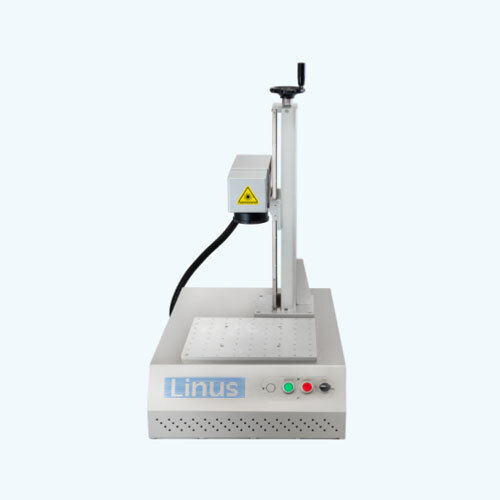
General Features and Benefits:
- Best results for most of the applications due to High Beam Quality
- Facility to couple the Machine with Automatic Robotic system
- Custom-made fixtures for Marking on Radial and Cross section surface
- Extreme Marking speeds, maximum speed up to 3000 mm/sec.
- Smooth running of machine due to electro-mechanically Stabilized Compact and Robust frame structure that nullifies the effect of vibration and surrounding conditions
- Advanced user-friendly software for fully controlled Marking Process
- Software compatible with BMP, JPG, PNG, TIF, PCX, TAG, DXF, GIF, PLT formats without restriction for font, code or graphics
- Password protection to prevent unauthorized access
LINUS Standard Specification
Linus-F20- 50
- Marking area : 50 mm x 50 mm
- Laser Source : Fiber Laser
- Max Average Power : 20 W @20 kHz
- Central Emission Wavelength : 1060-1070 nm
- Pulse Frequency : ≤ 50 kHz
- Polarization : Random
- Typical Beam Quality, M² : 1.6
- Marking Speed : Linear scan 6000 mm/s
- Min. Line Width : 0.020 mm
- Min. Character Size : 0.2 mm
- Repeat Accuracy : ± 0.01 mm
- Red Alignment Laser : Standard- Inbuilt
- Marking Graph : User-defined character, CAD data
- Supported Format : BMP, JPG, PNG, TIF, PCX, TAG, DXF, GIF, PLT
- Supply : 220 VAC± 10 %, 50 Hz
- Power Consumption : ˂ 1 kW Max.
- Room Temperature : 10 °C – 30 °C
- Humidity : 45%-75%
- Overall Dimensions In mm (L x B x H) : 720 x 500 x 940
Linus-F20- 100- Marking area : 100 mm x 100 mm
- Laser Source : Fiber Laser
- Max average power : 20 W @20 kHz
- Central Emission Wavelength : 1060-1070 nm
- Pulse Frequency : ≤ 50 kHz
- Polarization : Random
- Typical Beam Quality, M² : 1.6
- Marking speed : Linear scan 6000mm/s
- Min. line width : 0.020 mm
- Min. character size : 0.2 mm
- Repeat accuracy : ± 0.01 mm
- Red Alignment Laser : Standard- Inbuilt
- Marking Graph : User-defined character, CAD data
- Supported Format : BMP, JPG, PNG, TIF, PCX, TAG, DXF, GIF, PLT
- Supply : 220 VAC± 10 %, 50 Hz
- Power Consumption : ˂ 1 kW Max.
- Room Temperature : 10 °C – 30 °C
- Humidity : 45%-75%
- Overall Dimensions In mm (L x B x H) : 720 x 500 x 940
Linus-F20- 175- Marking area : 175 mm x 175 mm
- Laser Source : Fiber Laser
- Max average power : 20 W @20 kHz
- Central Emission Wavelength : 1060-1070 nm
- Pulse Frequency : ≤ 50 kHz
- Polarization : Random
- Typical Beam Quality, M² : 1.6
- Marking speed : Linear scan 6000mm/s
- Min. line width : 0.020 mm
- Min. character size : 0.2 mm
- Repeat accuracy : ± 0.01 mm
- Red Alignment Laser : Standard- Inbuilt
- Marking Graph : User-defined character, CAD data
- Supported Format : BMP, JPG, PNG, TIF, PCX, TAG, DXF, GIF, PLT
- Supply : 220 VAC± 10 %, 50 Hz
- Power Consumption : ˂ 1 kW Max.
- Room Temperature : 10 °C – 30 °C
- Humidity : 45 % - 75 %
- Overall Dimensions In mm (L x B x H) : 720 x 500 x 940
Advanced Fiber Laser Marking TechnologyHarnessing a 1064 nm IR fiber laser, this marking machine employs pulse frequencies ranging from 20kHz to 100kHz for precise engraving and marking. The high-quality Raycus, Max, or JPT laser source ensures durability and a minimum character size of 0.2mm, supporting even the most intricate marking requirements. The system operates cleanly and efficiently without consumables, positioning itself as a sustainable solution for your production line.
User-Friendly Control and Versatile CompatibilityIntegrated with the reliable EZCAD marking software and Windows OS support (XP/7/8/10, 32/64-bit), the LINUS F provides seamless user experience and broad compatibility with various graphic formats like AI, PLT, DXF, BMP, JPG, PNG, and TIF. The optional rotary attachment and configurable working areas offer versatility for marking curved and flat surfaces across different industries.
FAQ's of LINUS F Fiber Laser based, IR Laser Marking Machine:
Q: How does the LINUS F Fiber Laser Marking Machine achieve high marking precision?
A: The machine utilizes advanced fiber laser technology with a beam quality of M2 < 1.5 and a repeat positioning accuracy of 0.01mm. Combined with sophisticated control via EZCAD software, it enables ultra-fine marking with minimum line widths below 0.01mm and character sizes as small as 0.2mm.
Q: What materials can be marked with this laser marking machine?
A: The LINUS F is suitable for marking a wide range of materials, including metals (such as stainless steel and aluminum), plastics, ceramics, ABS, PVC, and epoxy resin, making it ideal for applications in electronics, automotive, medical devices, and other industries.
Q: When is it beneficial to use the LINUS F Fiber Laser for marking applications?
A: This machine is especially advantageous for high-volume, continuous operations that demand precise, high-speed, and consistent marking. Its 24/7 rated capacity and extremely long laser lifespan (>100,000 hours) make it suitable for industrial environments seeking minimal maintenance and operational downtime.
Q: Where should the LINUS F Fiber Laser Marking Machine be installed?
A: For optimal performance, install the machine in a clean, dust-free workspace maintained between 15C - 35C and 5% - 75% non-condensing humidity. These conditions ensure reliable marking quality and protect sensitive components over the lifespan of the equipment.
Q: What is the typical process for operating the LINUS F Laser Marking Machine?
A: Users design or import their marking files (AI, PLT, DXF, etc.) into the EZCAD software, configure marking parameters, and position the workpiece on the machine. Focusing is adjusted manually or automatically, and marking is initiated via PC control. Optional rotary attachments allow for marking on cylindrical surfaces.
Q: How does this machine benefit my production workflow?
A: The LINUS F delivers non-contact, highly precise marking without consumables, reducing ongoing operational costs and maintenance. Its fast marking speeds (up to 7000 mm/s), large configurable working area, and compatibility with automation allow for increased throughput and flexible integration into diverse manufacturing settings.